
- The weight of the secondary sector in the economy
- The industry
- Industrial location: factors and relocation
- Energy sources: types and importance
- Mining: definition and current problems
- The great industrial regions of the world
- The secondary sector in Europe
- The weight of the secondary sector in the economy
- The industry
- Industrial location: factors and relocation
- Energy sources: types and importance
- Mining: definition and current problems
- The great industrial regions of the world
- The secondary sector in Europe
- The secondary sector in Spain
The activities of the secondary sector are responsible for transforming raw materials into goods for use or into semi-finished products for use in a new transformation process.
Among these activities we highlight:
- Industry: is responsible for transforming raw materials into goods, thanks to machinery and labor.
- Construction: it is in charge of forming structures and infrastructures necessary to carry out the activities.
- Mining: consists of the extraction and exploitation of minerals and fossil fuels.
- Energy sources: responsible for providing the necessary power for the operation of the different activities.

The weight of the secondary sector in the economy
The weight of the secondary sector in a country’s economy is closely related to the percentage of the active population that works in this sector. To get an idea, we analyze a series of data on the importance of this sector in the world economy, the European Union and Spain.
In the European Union, the importance of the economic sectors is summarized in:
- Primary sector: 4%
- Secondary sector: 25%
- Tertiary sector: 71%
In Spain, according to the National Statistics Institute , we can observe how the distribution of economic sectors affects the following way:

- Active population: 23,000,000 people.
- Primary sector: 4.1%
- Secondary sector: 20.5%
- Tertiary sector: 75.4%
Without a doubt, the importance of this secondary sector has diminished over time in favor of the tertiary sector, but it is one of the bases for the functioning of society and the economy of this century. In addition, the reconversion of this sector towards new technologies and the new needs arising from the advancement of communications continue to play a key role in the economy of any country in the 21st century.
The industry
The need to transform the raw materials that nature provided into more elaborate products has always existed in the history of mankind. This work was done by craftsmen, but it was slow, expensive to make and expensive to sell. For this reason, when the technical advances and inventions of the 19th century allowed a greater productivity of craftsmanship, transforming products more quickly, cheaply and accessible to everyone, it meant a real revolution: the industrial revolution. Since then, the evolution of humanity reached heights never suspected and the speed of growth of societies was unstoppable.
Industry , thanks to machinery and labor, transforms raw materials for later use.
Factors influencing the industry :
- Physical : facilities, machinery, raw materials and energy. Cities close to the places where raw materials are obtained or with good communication networks to transport them quickly, as well as favoring the exit of products for the market are ideal places for their location. We cannot forget that the areas that also allow less investment when building factories due to their geographical characteristics are also points in favor.
- Economic : private or public money. The financial aid that governments can provide, tax exemptions and investment facilities have a strong influence on development.
- Politicians: legislation and possible State intervention. States that have social policies that allow measures that help in times of crisis, tax breaks for companies and the legislative freedoms that governments can grant to business directives influence the type of industry and development.
- Humans : labor according to the places. The amount of labor willing to work in production chains for certain wages or the attraction of these cities to obtain certain jobs (production managers, engineers, advisers, economists, etc.) are also decisive.
Industry Type:
- According to the amount of raw material:
- Heavy: they use large amounts of raw materials (steel, metallurgy, etc.)
- Semilleugera: they manufacture products that are used in other industries (machinery or automobiles).
- Light: they manufacture products for direct sale for consumption (textiles, food, etc.).
- According to the recipients of the products:
- Basic: they transform the raw material to be used by other industries (steel, metallurgy, etc.).
- Capital goods: they manufacture products that are made for use by other industries (machinery or automobiles).
- Consumer goods: they manufacture products for direct consumption (textiles, food, etc.).
- According to the size:
- Micro-enterprise: between 1 and 10 workers.
- Small company: between 10 and 50 workers.
- Medium company: between 50 and 250 workers.
- Large company: more than 250 workers.
- Depending on the product that works:
- Chemistry
- Alimentary
- textile
- car
- metallurgical
- Etc
Industrial location: factors and relocation
The location of industries is not due to fortuitous or isolated actions, but rather follows patterns or needs that lead to a dispersion of industrial areas according to a series of location factors:
1. Physical factors:
- The proximity of raw materials to factories to reduce transport costs.
- The proximity of energy sources.
- The topography of the site to make it easier and cheaper to build industrial infrastructure.
- The facility for the conservation of the environment .
2. Human factors:
- The workforce . The quantity of workers, their quality and qualification and their wages are very important aspects to consider.
- The proximity of the markets for the subsequent sale of the products, although it matters less and less in the global and technological society in which we live.
- Communication structures and means of transport to move raw materials and manufactured products.
- The capital or money to invest in the industry. This is what explains the industrial gap between the countries of the North and those of the South, which are much poorer and have less budget for investment.
- Country policy and legislation can make it easier or harder to set up businesses.
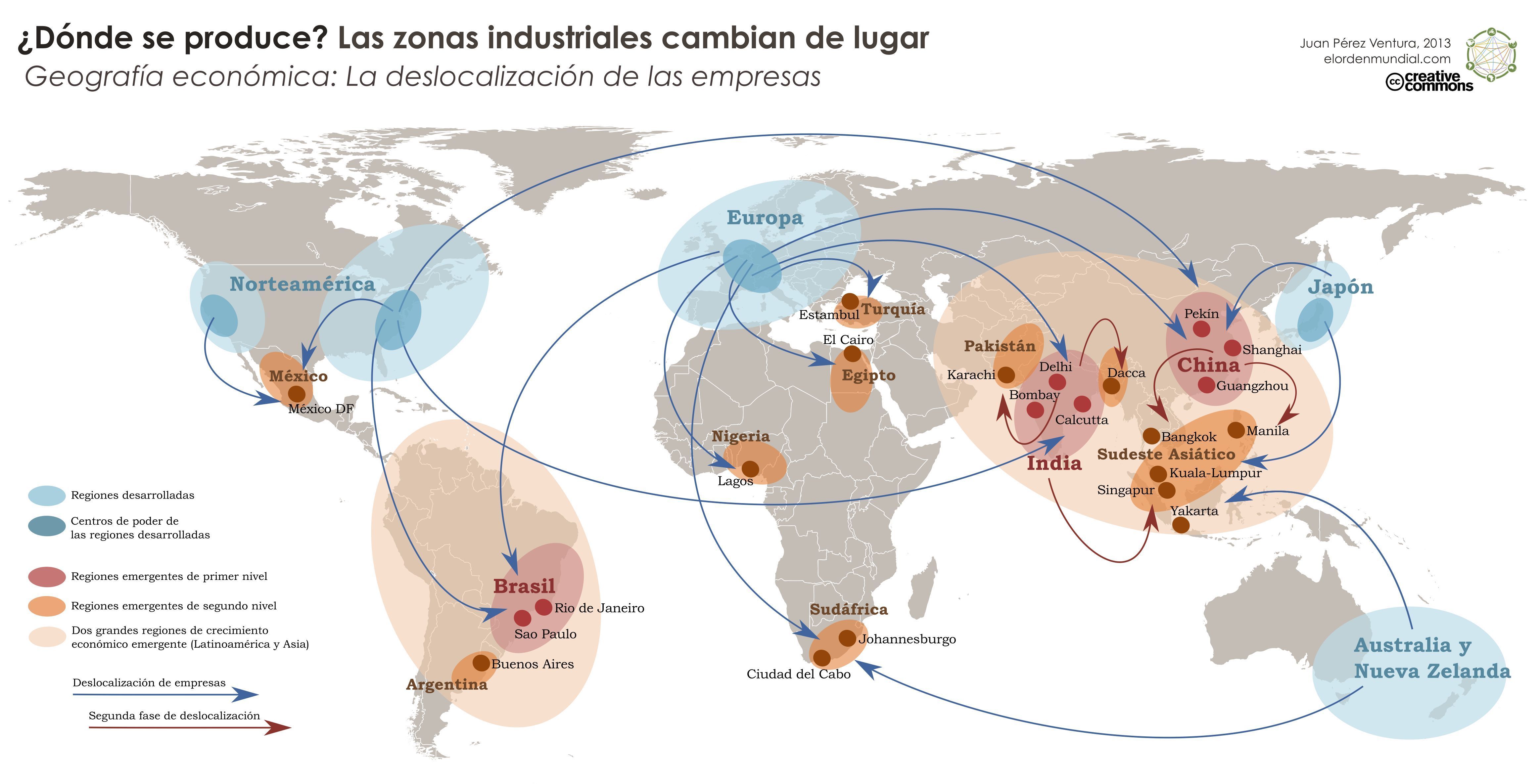
These facts have facilitated what is called industrial relocation. In other words, the transfer of companies to other countries, usually in developing countries, in search of more profits and the reduction of expenses. Currently, the importance of factors such as the proximity of resources, energy sources or markets has greatly decreased, because new technologies and the globalization of society allow production in one part of the world to sell at the other end.
The start of offshoring is caused by the existence of poor labor legislation and the abundance of cheap labor in less developed countries, where the factories are located, which allows the management to move away from the companies that are located in developed countries and increasing the economic differentiation between North and South. This leads to a series of consequences:
- Positives:
- The need for industrial conversion in more developed countries , betting on companies dedicated to more strategic and specific sectors such as high technology.
- Economic growth of less developed countries , entering the economic game of globalization and achieving their industrialization.
- Negatives:
- Increase in unemployment in developed countries due to the relocation of factories.
- Abuses in the working conditions of factory workers in poorer countries.

Undoubtedly, the negative consequences must be eradicated with the cooperation and participation of supranational bodies that look after the improvements of the workers, forcing fair legislation for the development of global markets.
Energy sources: types and importance
Energy sources are the resources provided by nature from which we obtain energy to produce mechanical work, light, heat, etc.
We can differentiate between two types of energy sources:
- Non-renewable: they are obtained from limited resources, and located in very specific areas of the world, so they can be exhausted.
- Coal: mineral obtained from the decomposition of plants which, by combustion, produces energy.
- Petroleum: is a fossil fuel, oily liquid and mixture of hydrocarbons that is produced inside the earth over time. From it, power is obtained through combustion.
- Natural gas: A fossil energy source, a mixture of light gaseous hydrocarbons, from which power can be obtained by combustion.
- Nuclear energy (uranium): energy obtained through the force caused by the fusion (union) or fission (separation) of atoms.
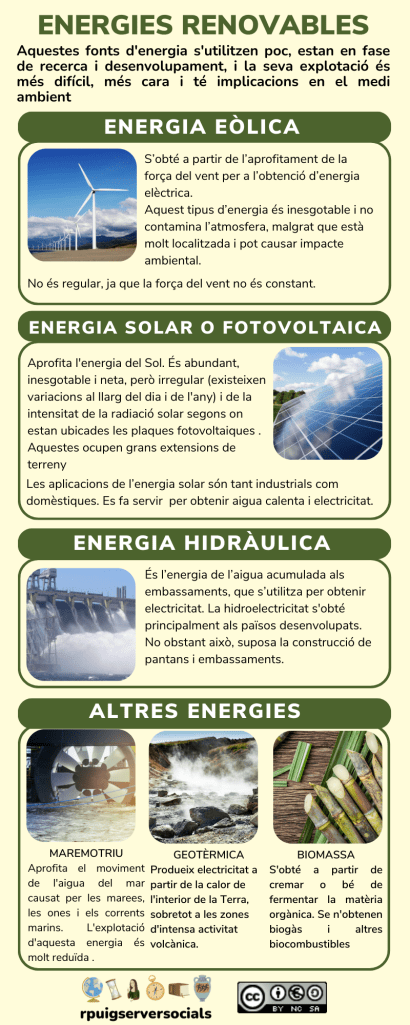
2. Renewable: they are unlimited and inexhaustible because the forces of nature themselves are responsible for providing them. The main problem is the high cost of infrastructure to obtain energy. They are:
- Wind power: harnessing the power of the wind.
- Solar: obtaining energy through the force obtained by sunlight.
- Hydraulics: energy obtained through the power of water movement.
- Geothermal: energy benefit from the heat of the Earth’s interior.
- Tidal: obtaining energy from the movement of the sea through the tides.
- Biomass: energy extraction through the burning of organic matter.
The importance of energy sources in today’s society is very great, since we use a large amount of devices and machinery, not only in productive sectors, but in our day-to-day life. For this reason, it is essential to find a way to use energy more efficiently, without losing energy power, looking for resource savings, less pollution and sustainable development .
“Sustainable development is defined as the satisfaction of “the needs of the present generation without compromising the ability of future generations to meet their own needs.” Report entitled “Our Common Future” of 1987, World Commission on the Environment and Development
To achieve this sustainable development that allows the world to continue to meet the needs of the following generations, the United Nations Organization (UN) proposes a series of objectives, the so-called Sustainable Development Goals (SDGs) , such as gender equality , quality education, zero poverty and hunger and actions for the climate . Undoubtedly, the use of renewable sources, lack of resources and care for the environment are the challenges for the future.
Energy problems
From the beginning of the Industrial Revolution at the end of the 18th century, energy sources were key to its development. The proximity of mines to industry first and, when these were exhausted, the need to find new locations for mines with minerals (coal first, oil later) were one of the main reasons that also drove colonization in the 19th century . In the 20th century, some wars and support for certain governments also hid the need to obtain certain sources of energy.
In the 1950s and 1960s, energy consumption was very intense to achieve economic growth after World War II . At that time there was a close relationship between the economic well-being indicators of societies and energy consumption. Thus, studies emerged that indicated that, if those consumption habits continued, a depletion of the available oil would occur at the dawn of the 21st century.
The increase in the price of a barrel of oil in the 1970s led to a severe energy and economic crisis that had a more noticeable impact on developing countries.
What we know as the “energy problem” arose , the concept of energy saving and the need to improve performance in the processes of production, transport and energy consumption . From then on, alternative energy sources to fossil fuels received a strong boost to solve environmental pollution, forcing the introduction of high added costs, due to the need to incorporate measures to reduce the environmental impact .

Therefore, the main challenges of energy problems can be summarized as:
- The need for energy saving.
- The obligation to improve performance in energy production and consumption.
- The importance of avoiding environmental pollution.
- The search for a sustainable development that allows the continuity of the level of production and avoids the exhaustion of resources.
- The need to look for alternative, clean and inexhaustible sources of energy.
- The political problems arising from the control of energy sources, mainly non-renewable.
- The increase in the price of industrial processes to convert them into the search for the best ones indicated above.
Mining: definition and current problems
Mining is the economic activity responsible for obtaining and extracting minerals and fossil fuels. While it is true that it works with raw materials and should therefore belong to the primary sector, its strong relationship with industry means that it is considered a more secondary activity.
The types of mines we find are:
- Open pit: mines that are on the surface and in the open air.

- Underground: mines with tunnels dug inside the earth’s crust to obtain minerals.

- Prospecting towers: they can be on land or at sea and they mix the previous types because, therefore, although the towers are on the surface, the extraction of fossil fuels takes place inside the earth. They are mainly used to obtain oil and gas.

The products that are most often extracted in the mines are:
- For energy : oil, gas, uranium and coal.
- For metallurgy (metal work): iron, copper, lead, pumice stone.
- Non-metallic : phosphates, nitrates and potassium salts for use in fertilisers, mainly.
The main problems and challenges facing mining are:
- The depletion of mines , especially in Europe. This means that there are a large number operating in developing or underdeveloped countries, as they have started their operation much later.
- The pollution generated by the waste (tailings) created in the processes of extraction and obtaining these products, affecting the environment and the health of the populations close to the mines.
- The reconversion of the sector when the mines run out or to avoid the high percentage of unemployment in a mining area, managing to adapt to changes in the economy of the area.
The future of mining
When we talk about mining we always go back to the past and see it as a backward and obsolete sector. Not much less! The products obtained from the mines are currently very necessary as fuels, to obtain construction materials, jewels or for new technologies.
For this reason, the mining sector must take several aspects into account for the future:
- The necessary rehabilitation of the spaces affected by the sector for environmental coexistence and reuse, for example, in the tourism sector.
- Mining is a sector that attracts investment and settles the population in small towns because it generates employment. However, it should be borne in mind that this may be temporary because it depends on possible depletion and options for the continuity of the area’s economy should always be considered when this happens.
- Consideration should be given to products used by industry in the 21st century and studies on the use of minerals in new compositions or materials for electronic devices.
- The technological sector must be the third backbone in an economic triangle alongside industry and mining for a prosperous future for these sectors.
In conclusion, mining activity must be converted to tourism in countries where the mines are running out. In addition, it is necessary to look for the extraction of another type of products more commonly used in the technology industry. In those places where the mining sector remains one of the main ones, usually developing or underdeveloped countries, the balance between exploitation and care of the environment should be sought, with international agreements and the support of supranational organizations.
The great industrial regions of the world
The distribution of industrial regions in the world is uneven and asymmetrical, distinguishing between richer and more modern areas, diverse in activities and respectful of the environment; while there are other areas with little industrial activity, more dispersed and influenced by local natural resources.
However, an industrial region is one where the weight of this type of activity in the economy is much higher than the rest of the sectors, employing the majority of the active population and influencing the nearby geographical area.
When exposing the great industrial regions of the world we will distinguish between:
1. Traditional industrial areas: these are the countries that first emerged after the Industrial Revolution and remain among the main regions.
- Europe: The United Kingdom, France, Germany, Italy and Spain are the most important industrial area in Europe, but with very localized areas in each country. The most important activities in this sector are those dedicated to transport (cars, ships and planes), biotechnology, steel, chemistry, food and textiles.
- United States: focused on the northeast area, highlighting the automotive industry and that dedicated to new technologies, especially biotechnology and nanotechnology.
- Japan: This country is dedicated to generating capital goods needed for other companies, as well as everything related to high technology. Since the last years of the 20th century, it has suffered an industrial slowdown due to competition from other Asian countries, but it remains one of the world’s main industrial engines.
2. Emerging industrial zones in the last decades of the 20th century.
- BRICS : are the countries with leadership in their area of influence and whose growth in the secondary sector has been developing since the 1970s.
- Brazil: it is the first country in South America that stands out strongly in the industry, which is related to its wealth in natural resources such as minerals, oil and gas. It also stands out in aeronautics.
- Russia: we must bear in mind that this area could be considered traditional due to the industrial development of the former USSR, but the political events experienced since 1989 and its subsequent economic evolution place it among these countries. The factories of the metallurgical sector (steel, aluminium, nickel), the chemical industry, the automotive industry and electronics are the main axes.
- India: Major industries are textiles, processed foods, chemicals, transportation equipment, steel, cement, petroleum, software , and pharmaceuticals. This country became independent in 1951 and since then it has turned to industry as the economic backbone of the country.
- China: With more than 40% of the country’s GDP, Chinese industry is the basis of the country’s economy, based on biomedicine, petrochemicals, automobiles, steel, and everything related to electronics and communications.
- South Africa: The chemical, processed food and beverage, transport equipment and metallurgical iron and steel industries are prominent.
- The “Asian tigers or dragons” (South Korea, Taiwan, Hong Kong and Singapore): are countries whose industrialization has been extraordinary since the 1960s, largely because of the amount of labor and its strategic location facing the sea, with tax and tariff exemptions, as well as labor legislation very favorable for companies.
3. Industrial regions of other continents.
Many of these countries begin economic and industrial modernization in the 1980s and 1990s. We highlight:
- Australia: The amount of energy and mineral resources they have have helped to develop the steel, metallurgical, textile and agri-food industries.
- Mexico: It has quickly emerged as the third power in the Americas, after the United States and Brazil, excelling in activities related to construction, beverages and food, and petrochemicals (makeup).
- South American countries: joining the industrial development of Brazil, they have focused on the extraction of minerals and oil, as well as everything related to agro-industrial activity.
- Africa: the coastal countries of the Mediterranean are the best placed to grow thanks to the relocation of European companies. However, it is expected that this continent will end up being the factory of the world as China is now, as its wealth of resources, labor and lax labor laws mean that many multinationals will look towards African continent, whose industrial development will be in this 21st century.
The secondary sector in Europe
Europe is characterized by a powerful industry; not surprisingly, industrialization arose and developed in European countries to, from there, export it to the rest of the world.
The use of energy sources in a technical way and the continent’s large mining deposits, crucial in the first moments of the Industrial Revolution, are also characteristics of the secondary sector in Europe. It must therefore be taken into account that, on this continent, there is a large amount of raw materials, although not enough to feed the entire industrial structure. In addition, there is a high dependence on oil for these sectors, which have to import it and are therefore dependent on the prices of the sellers.
However, Europe produces a large part of the world’s consumer goods, notably in the metals industry, those related to transport (automotive, aeronautics and naval) and light industries.
Industry in European countries has always been very localized in certain cities, so the sector is centralized in very specific areas: Manchester-Liverpool in the United Kingdom; the Ruhr area in Germany; Madrid-Catalonia in Spain; axis from Rotterdam to Milan, etc.
The industrial areas in which Europe stands out are the traditional ones such as metallurgy and steelmaking , but overturned towards the production of capital goods, and other industries such as those dedicated to the world of transport. The automobile, aeronautics and shipbuilding are also pillars of the European economy.
The industries producing consumer goods join hands in the desire to improve the competitiveness of their industry on a global scale and increase their autonomy and resilience, according to the policies carried out by the European Union.
Germany, France, the United Kingdom, Italy, Spain and the Netherlands concentrate 70% of total GDP and 30% of employment in the sector. These industries have a significant capital investment that allows a high technological level and high productivity. Large companies coexist with other small and medium-sized ones ( SMEs ), although the current trend is to increase competitiveness through mergers and agreements in order to compete in the market.
We can highlight several industrial areas:
- The central area of Europe with the first industrialized regions. We could draw an area that would go from Manchester to Milan, via the Rurh, as seen on the map.
- The Mediterranean territories that industrialized later, dependent on foreign companies but with a large weight of industry in their economies, as happens in Spain and Italy.
- Eastern European countries that , through the relocation of factories, are beginning to grow in this sector to have more qualified and cheaper labor, increasing company profits.
The United Kingdom , cradle of the Industrial Revolution, in the process of leaving the European Union, raises the question of industrial development on the continent and in this set of countries after this economic and political rupture. Undoubtedly, this event will mark the European economy, and even the world, since we must observe how this disunity will affect in all areas, which weakens Europe and can give wings to developing countries that may benefit from this circumstance. Only time can remove our doubts!

However, Europe lives a very different dichotomy between the countries of the continent, since we have the traditionally richest and most prosperous countries that have to face an industrial reconversion, based on technology and on the control of the directions of the companies Meanwhile, there are countries that have recently entered the European Union, which are hosting the relocation of factories that come to these countries for cheaper labor.
Bibliography
- Buxaweb.cat Secondary sector
- Manuel Salvador Jorge. Itinerary The secondary sector . Geography and History 3.º ESO . “Teaching Itineraries” INTEF collection.
 rpuigserversocials.com
Per publicar un comentari heu de iniciar sessió.